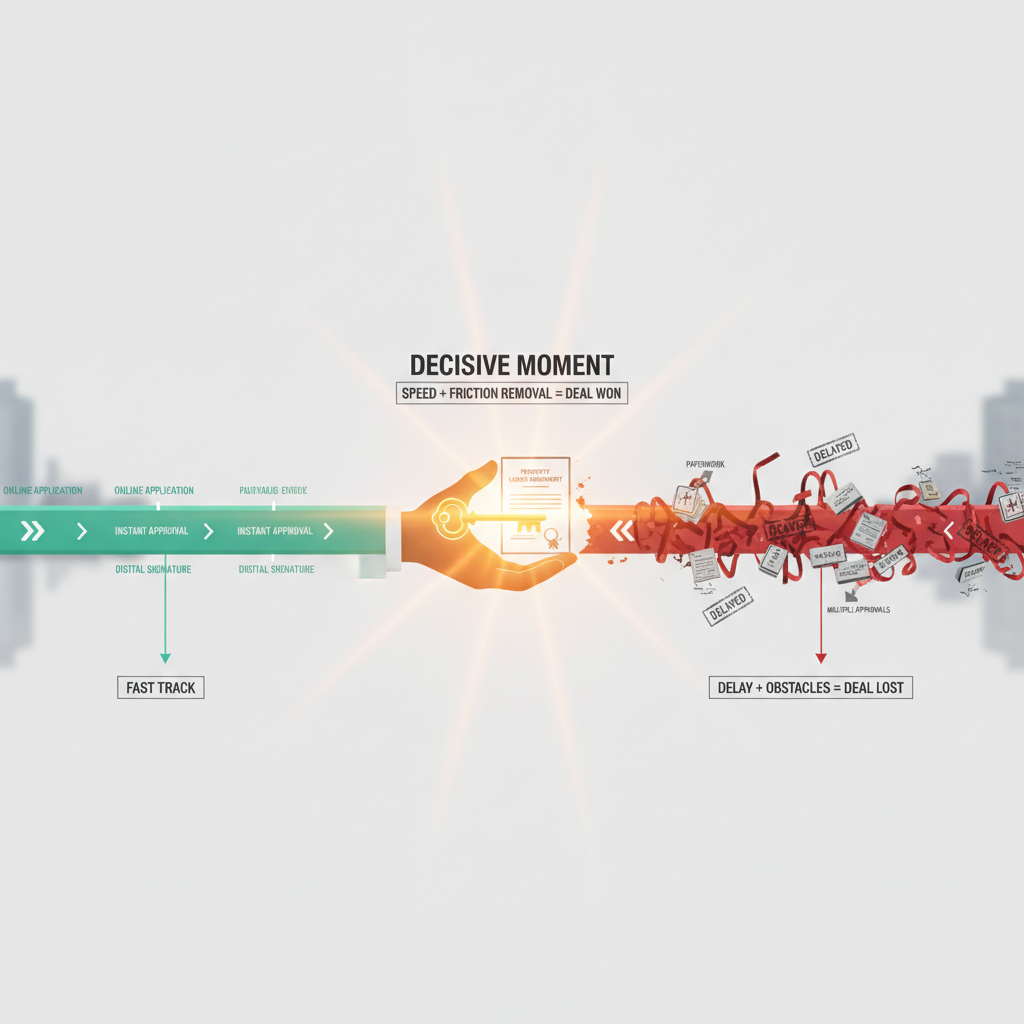
The moment a tenant decides to rent a property is shorter than most real estate agencies realize. Research, visits, comparison — all of that can stretch across weeks. But the actual decision to commit happens fast, and it is almost always triggered by the first agency that removes friction from the path forward.
The rental guarantee step is where that friction lives.
The Approval Window Is a Competitive Event
When a tenant submits a rental application, they are rarely talking to only one agency. In Brazil’s current market, where rising rents in cities like São Paulo, Curitiba, and Belo Horizonte have pushed more Brazilians toward renting rather than buying, demand is high and qualified tenants move quickly.
In the first quarter of 2025, average rental values climbed across most state capitals, driven by high demand and limited supply. A still-elevated Selic rate kept mortgage financing expensive and pushed more Brazilians into the rental market.
In a market like this, a tenant who finds a property they want is not going to wait two days for a credit analysis to come back.
The agencies that understand this treat guarantee approval not as a back-office formality but as a front-line conversion tool. The ones that don’t are handing closed deals to their competitors.
What Traditional Approval Actually Costs
The conventional rental guarantee process in Brazil was built for a different era. It required a guarantor — someone willing to co-sign the lease and assume liability for the tenant’s obligations. Finding that person, confirming their property ownership, gathering documentation, and running the analysis could take days. In many cases, it still does.
That delay has a real cost, and it is not abstract. A tenant who cannot produce a guarantor — which today describes the majority of applicants, given that younger renters, migrants, and first-time tenants rarely have a property-owning relative available — will either wait, look elsewhere, or simply give up on the property. Each of those outcomes is a lost contract.
The problem is compounded by the fact that the agencies most likely to rely on traditional guarantee processes are also the ones least likely to measure the conversion drop-off at that stage. They see a tenant who "didn’t close" and attribute it to price, location, or fit. The guarantee friction is invisible in the data because no one is looking for it.

Speed as a Structural Advantage
A digital rental guarantee changes the nature of this moment entirely. With Loft/Fiança Aluguel, credit analysis is completed in under one minute. The entire contracting process is 100% digital, with no need for a guarantor or security deposit. A tenant can move from application to approved guarantee within the same conversation — the same visit, in many cases.
This is not a marginal improvement in user experience. It is a structural shift in how the agency competes. When your approval takes 60 seconds and your competitor’s takes 48 hours, you are not operating in the same market. You are operating in a faster one.
Loft processes one new contract every 90 seconds across more than 800 Brazilian cities. That velocity is not an accident of scale — it is the product of a system designed to remove every unnecessary step between intent and signature.
The Tenant Profile Makes This More Urgent, Not Less
This context matters for how agencies think about guarantee selection — but it should not translate into approval processes that treat every applicant as a risk to be slowed down.
The data tells a more nuanced story.
Risk is not uniformly distributed, and a well-structured digital guarantee with proper credit analysis accounts for that — without making the process slower for everyone.
Loft has analyzed over 2 million customers across its platform. That depth of data means the credit model behind each approval is not a generic score lookup. It is a risk assessment built on the largest rental guarantee dataset in Brazil, calibrated to the actual behavior of Brazilian tenants across income levels, regions, and property types.
What the Guarantee Choice Signals to the Tenant
There is a dimension of this that agencies rarely discuss: what the guarantee process communicates to the tenant about the agency itself.
A tenant who is asked to produce a guarantor, gather notarized documents, and wait for manual analysis receives a clear signal about how this agency operates. That signal is not neutral. It tells them that working with this company will involve friction, paperwork, and waiting — before the lease is even signed.
A tenant who submits their information digitally, receives approval in under a minute, and signs the contract without ever needing to call anyone experiences something different. They experience an agency that respects their time. That experience shapes the relationship from the first moment, and it shapes whether they refer the agency to the next person who needs to rent.
The Guarantee Is Not the Last Step. It Is Where the Deal Is Won or Lost.
Most agencies sequence the rental process with guarantee approval near the end — after the visit, after the negotiation, after the tenant has already committed emotionally. That sequencing made sense when the guarantee was a slow, manual step that couldn’t be accelerated.
It no longer makes sense. When approval takes under a minute, there is no reason to treat the guarantee as a closing formality. It can be initiated earlier, resolved faster, and used as a competitive signal rather than a bureaucratic checkpoint.
The agencies that restructure around this reality — that move guarantee qualification earlier in the funnel and use speed of approval as a differentiator — will close more contracts from the same volume of leads. Not because they lowered their standards, but because they stopped letting process friction make the decision for them.
And the technology to make it is already available.


Deixe seu comentário